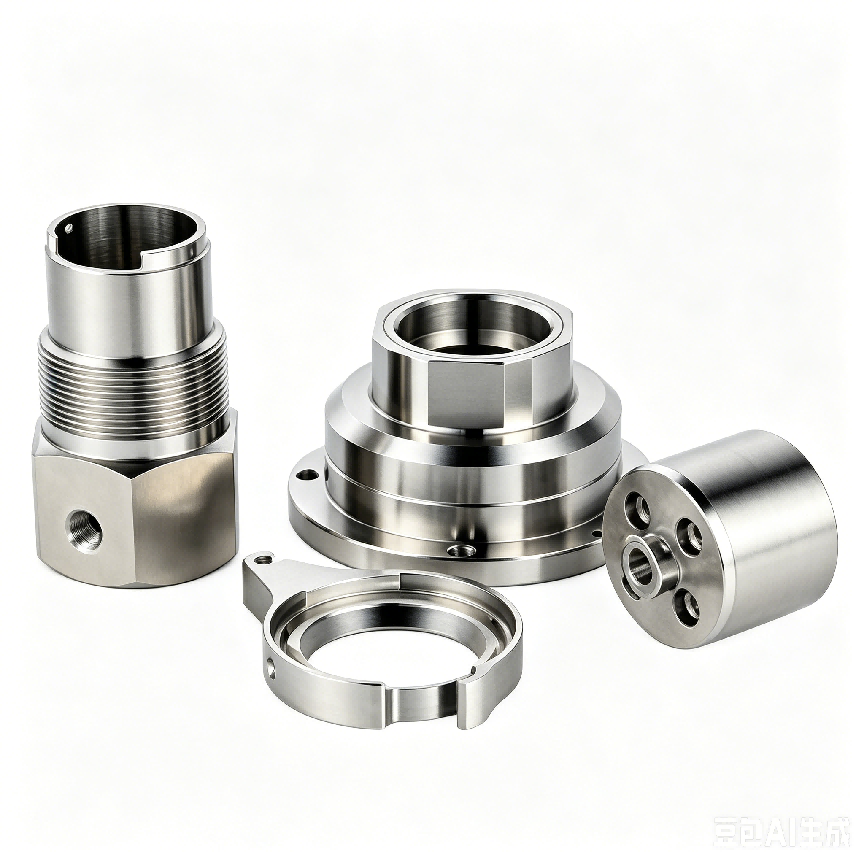
The main differences between turning and milling lie in the machining methods, suitable workpieces, and tool movements, among other factors. Both turning and milling are important methods in mechanical machining, each with its own characteristics and applications during the machining process. The following are some of the key differences between them: Machining Method: In turning, the workpiece rotates while the cutting tool moves axially or radially along the workpiece to perform the cut; in milling, the cutting tool rotates while the workpiece remains stationary or moves in various directions to perform the cut. Suitable Workpieces: Turning is suitable for machining workpieces with rotating surfaces, such as shafts, discs, and sleeves; milling is suitable for machining flat surfaces, grooves, and shaped surfaces. It can machine not only workpieces with regular geometric shapes but also those with complex shapes. Tool Movement: In turning, the tool typically performs only translational motion along a straight line or curve; in milling, the tool rotates, with each cutting edge periodically participating in intermittent cutting. Machining Accuracy and Surface Roughness: Both turning and milling can achieve high machining accuracy and surface quality, but the specific accuracy and roughness depend on factors such as machine tool performance, tool quality, and the selection of machining parameters. Generally, turning can achieve a machining accuracy of IT8–IT7, with a surface roughness Ra value of 1.6–0.8; the machining accuracy and surface roughness of milling are comparable to those of turning, but for certain specialized surface geometries—such as keyways, gears, and threads—milling may be more suitable. Machining Efficiency: Milling typically offers a higher material removal rate than turning; therefore, it may be more efficient when removing large amounts of material or performing rough machining. However, for certain specific machining tasks, such as machining slender shafts, turning may be the only viable option. Application of CNC Technology: With the advancement of CNC technology, CNC lathes and CNC milling machines have become widely used. CNC lathes can machine complex rotary shapes; CNC milling machines can machine complex shapes and features, such as three-axis or multi-axis milling and boring. In summary, turning and milling differ in terms of machining methods, suitable workpieces, tool movements, machining accuracy, machining efficiency, and the application of CNC technology. The choice of machining method should be determined based on the workpiece’s shape, dimensions, material, required machining accuracy, and surface roughness.